
THE VISION · WHAT THE RECORD SHOWS
The root problem
≈ 25 min read · or listen, or skim the bold lines
On this page
A · Primary source Statutes below were read in the Navajo Nation Code Annotated or the resolution itself. Candidate quotations come from Cal Nez’s interviews and are being checked against the recordings. How we verify →
All 42 candidate interviews, read against the Navajo Nation Code, show three distinct failures. Most public argument confuses them. They are: laws that exist but cannot be read in any one place; rules that meet at seams nobody owns; and a structure built in 1989 as temporary and never finished.
FINDING
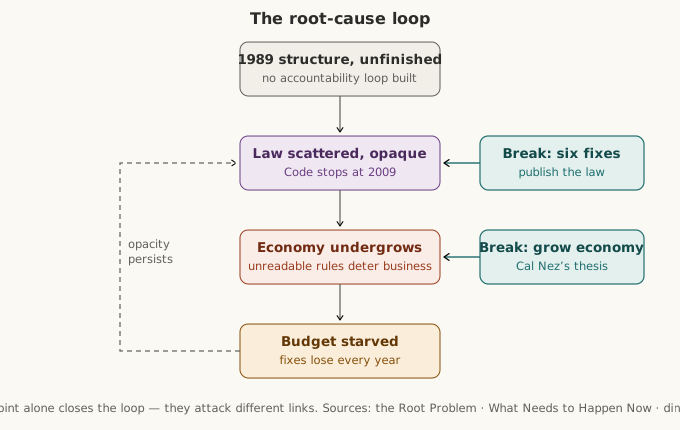
Tested against all 42 interviews (July 2026): 28 of the 42 candidates named at least one specific law, Title, named Act, or resolution in their interview, counted by keyword match against candidate turns. And the budget hypothesis — that the failures documented here trace back to appropriation decisions — holds broad support in the record: 32 of the 42 interviews discuss budget, funding, or appropriations substantively (three or more mentions in candidate turns). Andrew Curley states the connection directly: “Part of this infighting between president and council has to do with the fact that the budget wasn’t properly thought through initially” — and the full case is now its own article. The budget is not the engine of the root problem; it is the transmission — the loop diagram shows both.
All of it, in the plainest words
- The government was built in a hurry in 1989 and was supposed to be temporary. Nobody finished it. So nobody agrees who is in charge of what.
- The rules about spending money already exist. Advertise the job. Take bids. Don’t change the price by more than a fifth. Keep the paperwork where people can see it. Nobody checks.
- Navajo law stops at the edge of the Navajo Nation. The money and the harm walk across that edge, and come back for the patients and the contracts.
- And you cannot read the law in any one place. The last consolidated copy stops at 2009; everything since is scattered — an amendment summary here, resolutions by number on DiBB there — findable only if you already know what you’re looking for. The courts say copyright stops them from posting the annotated edition.
A people who cannot read their own law cannot hold anyone to it.
Failure one — the referee
Who has authority to hold power to account?
In December 1989, after the crisis that removed Chairman Peter MacDonald, the Council passed CD-68-89, restructuring the government into three branches. It did so, in the Council’s own words, temporarily — until the people established a government of their choice.
Thirty-seven years later the temporary government stands. The office created to finish the job has not finished it. In 2020 the Council amended that office’s plan of operations to add a duty to accomplish what it called “the People’s project.” Thirty-one years on, still a project.
The consequence is visible now. When the Nation tried to hold a president to account, nobody could agree who had the authority. A complaint was dismissed for lack of jurisdiction. A court froze the Council’s remedy. Nothing was decided on the merits.
Failure two — the plumbing
The safeguards exist. Almost nobody reads them.
Enacted by that same 1989 resolution, and never amended:
- 2 N.N.C. § 223(E) — “All contracts shall be awarded only after public advertisement and bidding.”
- § 223(F) — change orders shall not exceed twenty percent of the accepted bid.
- § 224 — every contract filed with Central Records.
- § 225 — “Access to contracts or papers shall be provided to the public.”
Meanwhile candidates told Cal Nez, unprompted, what they see. One said the Auditor General “couldn’t hire the special investigators to do some important work.” One proposed a “know your vendor law.” One — a registered, 100% Navajo-owned business — said “we’re priority one on Navajo. But we don’t get a lot of jobs on Navajo.”
A rule nobody checks is not a rule.
And the checking machinery exists too. Title 12 requires the annual budget to carry quantitative performance measures. It requires a budget impact analysis of every appropriation, on objective criteria, including the cost of failing to fund. It lets a program evaluation recommend that a program be discontinued.
And 12 N.N.C. § 9 provides that a program which ignores an audit’s corrective action plan loses ten percent of its funds — and its director loses twenty percent of their salary until it complies. For a chapter, twenty percent of chapter officials’ payments.
The Navajo Nation Code docks the pay of officials who ignore an audit. Almost nobody has read it.
Failure three — the boundary
Navajo law reaches Navajo entities on Navajo land. The money and the harm route around the edge.
This one has no villain. It is the shape of sovereignty in a world where companies incorporate elsewhere.
- CO-50-14 created the Navajo Department of Health — and gave it no authority to license physicians or clinics. The President’s own memo: the law “does not authorize the department to intercept or impede existing self-determination funding for our contracted and compacted facilities.”
- HIPAA is federal. The U.S. Office for Civil Rights enforces it. A 638 facility is a covered entity under law the Nation does not enforce.
- The NBOA governs who the Nation contracts with. It does not plainly reach whom a Navajo prime contractor subcontracts.
- Under Oliphant v. Suquamish (1978), tribal courts have no inherent criminal jurisdiction over non-Indians.
The Council saw it in 2014 and wrote it into the law’s own Findings: “States are encroaching on the Navajo Nation’s inherent sovereignty to regulate health care”; there is “no division, department, office or program… delegated or authorized as the primary agent to monitor, evaluate, regulate, enforce.”
Then it created a department and left the powers out.
And underneath all three
The published Navajo Nation Code stops at 2009
Amendments since then have never been codified. The Judicial Branch states it cannot post most statutes, citing copyright. The Office of Legislative Services publishes an amendment summary — it begins in 2014, leaving 2010 through 2013 in no government index at all. The most usable index of Navajo law is maintained not by the Nation but by a volunteer project staffed by law students at two universities off the Nation.
To learn what the law requires of a contract, an employer, or an official, a Diné person must assemble it from four sources — one of them a commercial subscription database.
A people who cannot read their own law cannot hold anyone to it — not a contractor, not a doctor, not a delegate, not a president. To be precise: the pieces exist — the 2009 Code online, an amendment sheet from 2014, resolutions by number on DiBB. What does not exist is one current, complete, findable body of law. Assembling it yourself is a research project, and the law should not be a research project.
FINDING
We tested “it’s all the budget” against the record. It did not hold.
Money is the most-discussed subject in the interviews — it appears substantively in 35 of the 42. So we asked a harder question: when a candidate describes something failing, do they name money as the cause in the same breath? 34 of the 42 describe a failure. Only about a quarter of those — 8 — link the failure to funding in the same sentence — and reading the hits one by one, a few of those are the word “funding” appearing near an unrelated complaint, not a causal claim.
What candidates do describe, in their own words, is money that already exists and does not move: chapter allocations and capital-improvement funds “sitting there,” year after year; a signed budget policy that leaders then work around. That is not a starved budget. It is an unspent one — a failure of the machinery between the appropriation and the road, the clinic, the chapter house.
So the honest form of the claim is narrower and stronger than “the budget is the root problem.” The budget is where the other three failures become permanent — a law that isn’t codified because codifying it never wins a line; a seam that stays unstaffed because staffing it never wins a vote. The budget is the transmission. The unfinished 1989 structure is the engine. And the loop closes because opacity costs nothing to the people who could end it.
Not because anyone is unwilling. Because the standard cannot be looked up.
And the court’s own decisions are sold as books.
The Navajo Nation Supreme Court publishes its opinions in bound volumes — the Navajo Reporter. They are sold at the Diné College Book Store, in volumes one through nine, at $45 to $100 per volume.
In its own First Quarter report for Fiscal Year 2023, the Judicial Branch recorded the number of copies sold that quarter:
Six.
The Judicial Branch publishes how many cases it closed. It sells the reasons.
What government reform does and does not fix
| Failure | Does the proposed constitution address it? |
|---|---|
| The referee | Yes, seriously. Removal moves from a Council vote to recall by the people. An Inspector General sits in a separate house and would oversee the chapters. |
| The plumbing | No. In the draft reviewed, the word “procurement” does not appear. No bidding requirement. No change-order cap. The proposal would supersede Title 2, where those rules live. |
| The boundary | It cannot. A constitution reorganizes the houses of a government. It cannot extend jurisdiction over a company incorporated in another state. |
| Workers | Silent. The words whistleblower, retaliation, and adverse action appear zero times. “Just cause” appears twice — both times protecting officials. |
The measurement, taken from the inside
D · Draft — not verified Counts below come from keyword matching against machine transcripts, not from a volunteer reading every answer. Directional, not definitive. How we verify →
We read 348 candidate answers from the 39 transcribed interviews (of 41 at the time; the record is now 42 and this analysis has not yet been re-run — see the canonical counts), across Cal Nez’s seven areas and asked two questions of them.
Did candidates propose real mechanisms?
Yes — 170 of 348 answers (48%) contained something actionable: legislation, an audit, a bid, a board, a budget line, a training program, a reporting requirement.
Only 9% were sentiment with no mechanism at all. Candidates were far more concrete than the caricature suggests.
But look at which area produced the fewest.
| Area | Answers with a mechanism |
|---|---|
| The executive–legislative conflict | 60% |
| Ranches & enterprises | 59% |
| Education | 56% |
| Health care & 638 | 48% |
| Veterans | 45% |
| Economic development & the NBOA | 44% |
| Government reform | 30% |
The one area that is entirely about law produced the fewest concrete fixes.
Did they cite the law?
28 of the 42 transcribed interviews named a Navajo law — Title 2, Title 26, the NBOA, the NPEA, the Local Governance Act. They know these laws exist. They argue about them.
The number who cited a section of the Navajo Nation Code, in 348 answers:
One.
LaVonne Tsosie cited Title II §102 and the §164 review process on tape — the only candidate in the archive to cite sections of the Navajo Nation Code. The only other person in the archive to do so was Rodriquez Morris, the former Director of the Office of Ethics & Rules — who cited § 3780, twice. He is not a candidate. He ran the office.
Three candidates did cite a section — of federal law. All three named Section 17, the federal corporate charter provision (25 U.S.C. § 5124).
They cited the law they can actually read. Federal law is published, free, online, and searchable. The Navajo Nation Code stops at 2009.
And a caution: law is not the root of everything
Three root causes, not one
It would be easy — and wrong — to read this page and conclude that every problem on the Navajo Nation is a legal problem. It is not.
| Root cause | What it looks like | What fixes it |
|---|---|---|
| Scarcity | Hauling water. A road that washes out again. A veteran driving to Albuquerque. No teacher willing to move to Kayenta. | Money, distance, federal advocacy |
| Capacity — the budget | The Auditor General cannot hire investigators. The ethics office has no barred attorney. Nobody is in the seat. | Showing up at the public budget hearings. Not a secret — a choice |
| Legibility & enforcement | Nobody can read the rule. Nobody checks whether it was followed. | Publishing, funding, and someone deciding to look |
Reading § 223 does not build a clinic in Chinle. No statute hauls water. The sober-living scheme and the wound-graft prosecutions happened under federal and Arizona law, in Phoenix — no Navajo statute reaches them.
And ZenniHome cuts against us too. § 223(E) required bidding. § 223(F) capped change orders. The law was there. Nobody checked. That is an enforcement failure, not a reading failure.
So here is the version that holds
Law is not the root of most problems. It is the root of most failures to fix them.
Water is a money problem — until you ask where the water contract went, and no one can see it. Veterans need a clinic — until you ask whether the money was bid, and no one can check.
Scarcity explains why the problems exist. Legibility explains why they persist.
The budget is not a secret. It is a choice.
C · Secondary explanation Drawn from the Council’s own resolutions, the Budget & Finance Committee’s public hearing record, and published reporting. The statute has not been read directly. How we verify →
It would be easy to assume the Nation’s money is hidden. It is not. Of everything on this page, the budget may be the most visible thing the Navajo Nation does.
Who decides, in order
- The Office of Management & Budget (executive branch) sets planning base amounts.
- The Budget & Finance Committee approves the Budget Instruction Manual — published online.
- Public hearings are held at each of the five agencies, across three states.
- Oversight committees review each division.
- Naabik’íyáti’ advances it. The full Council votes.
- The President has ten calendar days to sign or veto.
And the people have a say — in the statute
12 N.N.C. §§ 800 and 840(A): the Budget & Finance Committee may hold public hearings at each agency and take testimony on the budget, and plan for adequate funding of services desired by the Navajo People.
How: register, fill out a “Request to Speak” form, attach written testimony or a chapter resolution. Committee members may only consider what is on the record — so private lobbying does not count and public testimony does.
It works. After the August 2025 hearings, the Committee reallocated $15,734,802, preserved 236 jobs, and corrected a $2.2 million chapter shortfall. The Vice Chair said every decision was “informed by what we heard in the chapters.”
So why is the Auditor General understaffed?
Not because the budget is hidden. Because, in public, at a hearing, with testimony taken, by a recorded vote — the Nation funded other things.
That is a different problem, with a different fix.
A budget nobody can see needs publishing. A budget everyone can see and nobody contests needs somebody to show up.
The hearings happen every year, at all five agencies. Almost nobody comes for the watchdogs.
The to-do list
Every item below is fixable. None requires an election.
Ordered by what controls what
A root issue is one that controls the others. Two do. The rest are worth doing on their own merits.
The two that control everything else:
- Can anyone read the rule? A statute nobody can find cannot be invoked. 28 of the 42 candidates named a Navajo law, Title, named Act, or resolution. None cited a section of one.
- Can the watchdog be dismissed by the body it watches? 12 N.N.C. § 3(B): the Auditor General “may be removed at any time by majority vote of the Navajo Nation Council” — and hiring is “subject to… budgetary constraints.”
A rule nobody can read cannot be invoked. A watchdog who can be fired will not enforce. Fix either alone and you have half a system.
Things that are a budget line, a filing cabinet, or a bill
- Publish an up-to-date, indexed Navajo Nation Code, free. The last one stops at 2009. This is a budget line.
- Publish the Navajo Nation Labor Commission’s decisions. No employee or employer can currently look up how “just cause” has been applied. This is a filing cabinet.
- Fund the Auditor General to hire investigators. This is a vote.
- Pass a general whistleblower act. Two provisions exist — 2 N.N.C. § 3767 protects parties and witnesses to an ethics complaint, and 15 N.N.C. § 610(N) protects anyone who files a charge or testifies under the NPEA. Neither protects someone who reports wrongdoing to a regulator, to law enforcement, or to the public. This is a bill. A chapter can pass a resolution asking for it.
- Fill the Ethics & Rules director and presenting officer positions with barred attorneys, as the law requires.
- Amend the ethics code. It still names an Ethics & Rules Committee abolished when the Council went from 88 delegates to 24.
- Decide whether the Navajo Department of Health should license physicians and reach 638 funding. The Council saw the need in 2014 and did not grant the power.
- Ask, before November 3, whether the constitution preserves 2 N.N.C. §§ 223–225.
And what you can do
Some of this does not need the government at all.
2 N.N.C. § 225 says access to contracts “shall be provided to the public.” Any Diné person may ask to see a contract the Nation signed — with its change orders and the record of bidding. It has said so since 1989.
How we got here
Nobody could have found this in the law alone — § 223 is one paragraph on page 98 of 2,804. And nobody could have found it in the interviews alone — the candidates knew something was wrong with contracts; not one could cite the section.
It took both. Cal Nez’s interviews said where to look. The Code said what was there.
Related: The Threads · The Runaround · Title 2 & Title 26 101 · Who watches the money? · What you can do now · How we verify
Where authority changes hands: The Seams →
Put the to-do list to the candidates:
The records: What should be public →
A matching game: Who holds the power? →
The basic things: what you cannot get →
Why this law exists
In 1987 a middleman bought a ranch for $26.25 million and sold it to the Navajo Nation five minutes later for $33.4 million. Two years of crisis followed. On July 20, 1989, Arnold Begay and Jimmy Dixon were killed outside the finance building in Window Rock.
Five months later the Council wrote 2 N.N.C. §§ 223–225: advertise the contract, take bids, cap change orders at twenty percent, file it, and let the people see it. In the same resolution they ordered that the law be codified immediately.
What we cannot yet answer: What we don’t know →
Who enforces which sections: The Office of Ethics & Rules and 2 N.N.C. §§ 3744–3784 →
Every office named on this page: Who does what →
Question by question:
The public-access law we finally have a citation for
A · read in the Navajo Nation Code Annotated
12 N.N.C. § 309 — Public access to procurement information:
“Procurement information shall be available to the public to the extent provided by the Navajo Nation Privacy and Access to Information Act, 2 N.N.C. § 81 et seq.”
This site has said for months that the Nation may already have a records law as strong as FOIA, and that nobody had looked. Now we have its citation: 2 N.N.C. § 81.
It has not yet been read. When a volunteer reads it, this page changes. What we don’t know →
And the Auditor General’s powers are larger than anyone says
12 N.N.C. § 5 — Disclosure of records: officials and employees of “all Navajo Nation programs, divisions, entities, chapters, and enterprises shall make their books and records available” to the Auditor General on request, “within a reasonable period of time.”
§ 2(A)(1) lets the office audit “chapters, related Navajo Nation entities and contractors to the Navajo Nation.”
§ 2(A)(4) directs it to assist the Office of the Prosecutor and the Ethics & Rules Office in investigations.
§ 9 — when a program fails to implement a corrective action plan, the Auditor General “shall immediately report that failure” and the Controller shall withhold ten percent of monies payable.
§ 3(B) — the Auditor General is appointed by the Speaker, confirmed by the Council, and “shall serve at the pleasure of the Navajo Nation Council.”
The office that audits the Council serves at the pleasure of the Council — and cannot hire enough investigators to do it.
The audit loop, drawn: The Auditor General →
The NBOA requires competitive bidding
A · read in the Navajo Nation Code Annotated
The Navajo Business Opportunity Act does more than govern who may get a contract — it requires competitive bidding, names an enforcer, and sets sanctions.
5 N.N.C. § 205 — Navajo Business Opportunity Procedures in Bidding and Procurement
(B) Advertisement and notice. After preparing a bid or request for proposal solicitation, the procuring entity shall:
1. Provide notice or invitation to bid in a newspaper having general circulation within the Navajo Nation; or
2. Provide notice or invitation to bid by mail or telefax to certified businesses listed on the Navajo Nation Business Source List compiled and maintained by the Business Regulatory Department; and
3. The notice shall include the specifications, the deadline dates for submission of bids, bid openings, award, and the necessary qualifications.
§ 205(C) requires the maximum feasible price to be determined before bids are solicited.
And it names an enforcer
§ 209(A): “All proposed professional services, procurement and construction contracts shall be initially reviewed by the Business Regulatory Department for compliance with the Act.”
§ 209(B): the Department shall investigate any alleged violation on receipt of a written complaint, prepare a written summary of facts and witness statements, seek voluntary compliance, and if that fails, render a decision. § 209(C) provides for interim project suspension, temporary restraining orders and permanent injunctions.
§ 210 — sanctions: civil fines up to $500 per day, per violation; suspension or termination of a party’s authorization to do business on the Navajo Nation; a bar on future business, for a period or permanently.
And five Titles are not in the published Code at all
The volume lists them. It does not print them.
A · verified page by page in the Navajo Nation Code Annotated
The published Code Annotated opens with a table of contents naming Titles 1 through 26.
Twenty of them are printed. Five are not.
Five Titles of the published Code — including Title 3 (grazing) and Title 26 (the Local Governance Act) — were never printed in the volumes. The full Title-by-Title table lives on one page, kept current in one place: which Titles are in the volume →
What that means, in plain words
A Diné person holding the published Code cannot read the law that governs their grazing permit.
They cannot read the law that governs their land.
They cannot read the law that governs their chapter.
They cannot read the law that governs who inherits when a relative dies.
And twelve days before a primary, they cannot read the election law.
Why this explains what the interviews showed
Andrew Curley calls land reform the number one issue on the Navajo Nation. He researched it at the Diné Policy Institute. The law he is talking about is not in the published Code.
Lewnell Harrison says certified chapters no longer go through the Auditor General. Nobody can check him. Title 26 is not in the published Code.
Of the 42 candidates on the record (as of July 2026), one — LaVonne Tsosie — cited sections of Navajo law on tape: Title II §102 and the §164 review process.
Three others cited Section 17 — a federal provision. Title II is one of the Titles that IS published. The pattern holds: people cited the law they could read.