
CIVIC ACADEMY · PLAIN LANGUAGE
The Auditor General
≈ 4 min read · or listen, or skim the bold lines
A · Primary source Every section below was read in the Navajo Nation Code Annotated, 12 N.N.C. §§ 1–9. How we verify →
Candidates say this office cannot hire enough investigators. Almost nobody says what it is, what it may demand, or what happens when a program ignores it. All of that is written down.
The whole thing, in six sentences
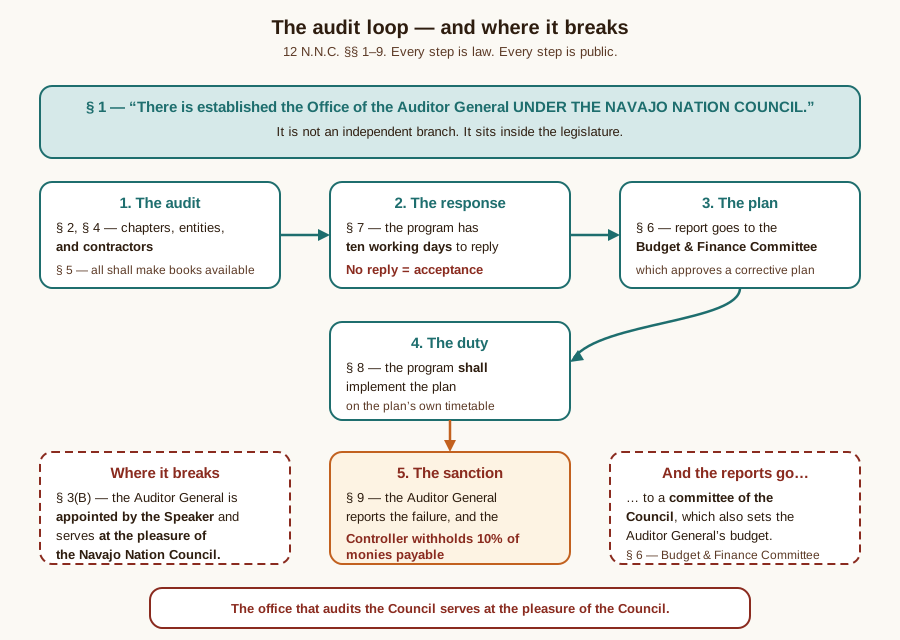
- The Auditor General audits chapters, programs, enterprises — and contractors to the Nation.
- Everyone must hand over their books. It is not optional.
- The audited program gets ten working days to reply. Silence counts as agreement.
- The report goes to the Budget & Finance Committee, which approves a corrective action plan.
- The program then has a duty to carry that plan out.
- If it doesn’t, the Controller withholds ten percent of its money.
That is a complete accountability system. It is thirty-five years old. And the office that runs it sits inside the body it audits.
Which branch is it in?
§ 1 — Establishment
“There is established the Office of the Auditor General under the Navajo Nation Council.”
The legislative branch. Not an independent office. Not the executive. Not the courts.
§ 3(B): the Auditor General is appointed by the Speaker of the Navajo Nation Council, at a negotiated salary, subject to confirmation by the Council, and “shall serve at the pleasure of the Navajo Nation Council.”
They must be an actively licensed Certified Public Accountant, Certified Internal Auditor, or comparable, and are bound by a professional code.
What it may demand
§ 5 — Disclosure of records
“Officials and employees of all Navajo Nation programs, divisions, entities, chapters, and enterprises shall make their books and records available to the staff of Office of the Auditor General upon request… within a reasonable period of time.”
“Shall.” Not “may.”
§ 2(A)(1) extends the audit power to “chapters, related Navajo Nation entities and contractors to the Navajo Nation.” A contractor’s financial records are auditable.
§ 2(A)(4) directs the office to assist the Office of the Prosecutor and the Ethics & Rules Office in investigations.
The sanction nobody talks about
§ 9 — Sanctions for failure to implement plan
When a program, division, chapter, enterprise or entity fails to implement the corrective action plan approved by the Budget & Finance Committee within the plan’s timetable, the Auditor General “shall immediately report that failure to the Controller of the Navajo Nation and to the Budget and Finance Committee.”
“As a sanction for failure to implement the corrective action plan, the Controller shall cause ten percent (10%) of monies payable from any governmental fund of the Navajo Nation… to be withheld.”
Ten percent. Automatically. Written in the Code.
And the rule most people would never guess
§ 7 — ten working days
After receiving the final draft of an audit report, the audited program has ten working days to submit written comments. It may request up to five more, with justification.
“Failure of an audited program to submit a response shall be deemed to constitute an acceptance of the final draft of the audit report by the program.”
Silence is agreement. A program that says nothing has accepted the findings against it. The response may not exceed five pages.
§ 8: once the Budget & Finance Committee approves the corrective action plan, the program “shall have a duty to implement” it.
So where does it break?
Not in the law. In the design, and in the budget.
The office that audits the Council is established under the Council (§ 1), appointed by the Speaker (§ 3(B)), serves at the Council’s pleasure (§ 3(B)), and reports to a Council committee (§ 6) — the same committee that sets its budget.
Meanwhile a candidate told Cal Nez the Auditor General “couldn’t hire the special investigators to do some important work.” D · a claim, not a number
That is not a legibility problem. The law is clear. It is a capacity problem, and its fix is a budget line — decided in public, at hearings held at all five agencies, where almost nobody comes to ask for it.
Show up at the budget hearing → The budget is not a secret →
Five questions for a candidate
- 12 N.N.C. § 3(B) says the Auditor General serves at the pleasure of the Council. Should the Nation’s auditor serve at the pleasure of the body it audits?
- § 9 requires the Controller to withhold ten percent when a corrective plan is ignored. When was that last applied?
- § 5 says every program shall hand over its books. Has any refused?
- § 2(A)(1) lets the office audit contractors to the Nation. When did it last audit one?
- What is the Auditor General’s current budget, and would you increase it?
Related: Who does what · Audit & Performance Review 101 · Who enforces what · The Root Problem