
CIVIC ACADEMY · PLAIN LANGUAGE
Who watches the money in health care?
≈ 6 min read · or listen, or skim the bold lines
A · Primary source The Navajo law below was read from the resolution itself. The federal laws are cited from the U.S. Department of Health and Human Services, Office of Inspector General. How we verify →
A doctor treats your grandmother. Someone sends a bill. Who checks that bill? The answer is not what most people think — and it explains a lot.
The short version
- Doctors get paid by Medicare and Medicaid — money from Washington and Phoenix.
- An outside company can treat Diné patients right here on the Nation, and send the bill straight to Washington.
- The Navajo Nation is not the one paying. So Navajo contract rules never come into it.
- The hospital board may never see the bill.
- The clerk in Washington who pays it has never been to Tuba City.
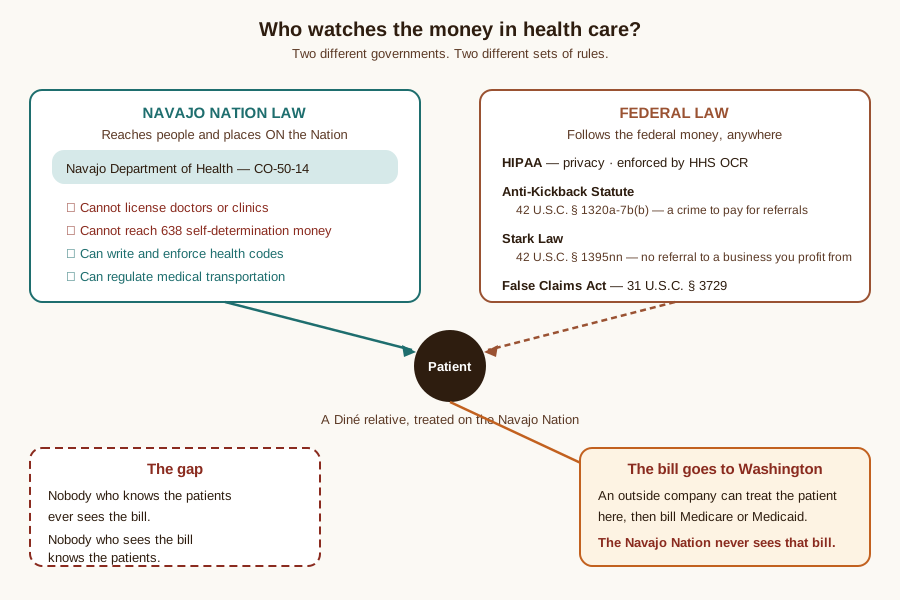
- Nobody who knows the patients ever sees the bill. Nobody who sees the bill knows the patients.
Start with two words
IHS and 638
IHS means the Indian Health Service. That is the federal government running a hospital directly.
638 means the tribe runs the hospital instead, using federal money. The name comes from a federal law, Public Law 93-638. Tuba City and Winslow are 638 hospitals. They have their own boards.
Both kinds of hospitals get money from Washington. Both also bill Medicare (for elders and some disabled people) and Medicaid (called AHCCCS in Arizona).
What the Navajo Nation can do
In 2014 the Council passed a law called CO-50-14. It created the Navajo Department of Health. President Ben Shelly called it “the first tribally operated, state-like health department.”
It sounds strong. Read the law and you find two things it cannot do.
What CO-50-14 does not give the Nation
1. It does not let the Nation license doctors or clinics. The law lets the Department write and enforce health codes — but it must write them first. The only people it plainly licenses are traditional practitioners and medical transportation services.
2. It does not let the Nation touch 638 money. President Shelly wrote it plainly when he signed it: the law “does not authorize the department to intercept or impede existing self-determination funding for our contracted and compacted facilities.”
The Council saw the hole. It said so in the law’s own findings: there is “no division, department, office or program… delegated or authorized as the primary agent to monitor, evaluate, regulate, enforce.” And: “States are encroaching on the Navajo Nation’s inherent sovereignty to regulate health care.”
Then it created a department and left out the two powers that would have closed the hole.
What only the federal government can do
Some rules about health care money are federal. The Navajo Nation does not enforce them. They follow the federal money, wherever it goes.
HIPAA — your privacy
Your medical records are protected by a federal law called HIPAA. The Navajo Nation does not enforce it. The U.S. Office for Civil Rights does. A 638 hospital is covered by HIPAA just like any hospital.
Anti-Kickback Statute
42 U.S.C. § 1320a-7b(b). It is a crime to pay someone — or take payment — to send patients your way, when Medicare or Medicaid pays the bill.
“Payment” means anything of value: cash, free rent, gifts, a big consulting fee.
Stark Law
42 U.S.C. § 1395nn. A doctor may not send a Medicare patient for certain services to a business the doctor makes money from — or that a close family member makes money from — unless the arrangement fits an exception.
False Claims Act
31 U.S.C. § 3729. It is illegal to send Medicare or Medicaid a bill you know is false.
And it has a whistleblower part. A private person can sue on behalf of the United States when they see fraud against a federal program.
Now put the two together
The gap, in one sentence
Nobody who knows the patients ever sees the bill. Nobody who sees the bill knows the patients.
An outside company can treat Diné patients here, on the Navajo Nation, and send the bill straight to Medicare in Washington. The Navajo Nation is not the payer. So Navajo contracting law never comes into it. The hospital board may never see the invoice. And the federal clerk paying the claim has never been to Tuba City and does not know what a normal visit costs here.
That is not a loophole somebody built. It is the edge of the Nation’s authority — and the money keeps stepping over it.
Where we have seen this before
The site’s Modern Vascular case study follows a chain of clinics in border towns that treated many Navajo patients and billed Medicare and Medicaid — while sitting outside every oversight ring the Nation controls. The Nation’s licensing authority reaches providers on the Navajo Nation. It does not reach an LLC in Phoenix or Farmington.
The sober-living case study follows the other direction: relatives were recruited on the Nation and taken to the Valley, where the bills went to Arizona Medicaid.
Same edge. Crossed both ways.
A word about names
These case studies name no private individuals and reach no verdict beyond what courts have. Some matters ended in indictments or guilty pleas. Others remain allegations, or civil claims, or nothing at all.
An indictment is an allegation. Everyone is presumed innocent until proven guilty beyond a reasonable doubt. We say so every time, because it is true every time.
What this means for you
- If it is about your medical privacy — that is federal. Go to the U.S. Office for Civil Rights, not the Nation. There is a clock.
- If it is about a bill sent to Medicare or Medicaid — that is federal too. HHS-OIG has a hotline: 1-800-HHS-TIPS.
- If it is about a Navajo Nation contract — that is ours. You may ask to see it, under 2 N.N.C. § 225.
- If you are afraid of losing your job for saying something — the Navajo Nation has no whistleblower act. Federal law may protect you. Read this first, then talk to an attorney.
The questions to ask a candidate
- CO-50-14 gave the Navajo Department of Health no power to license doctors and no reach into 638 money. Should it have both?
- When an outside company bills Medicare for care given to Diné patients on the Navajo Nation, who is supposed to see that bill?
- 638 hospitals have their own boards. Who checks the boards?
- The Nation has no general whistleblower act — only § 3767 and § 610(N), both tied to a formal complaint. Would you sponsor one?
Related: CO-50-14 — the enabling law · Healthcare 101 · Healthcare & 638 · Modern Vascular · What you can do now
This is one of three failures. See all three →
This gap has a name and a shape. The Seams →
Your medical privacy: HIPAA 101 — and what an accusation requires →