
The record, read closely · the one to read first
The whole picture
≈ 5 min read · or listen, or skim the bold lines
D · Draft — not verified This is a living article: it is revised as the record grows, and every claim in it links to the page where that claim is verified. Last revised July 9, 2026 (budget finding re-tested against all 42; loop diagram added). How we verify →
The whole journey — four steps
Where we came from: The history of Navajo government
Where we are: What runs through all of it · The root problem
Where we want to be: Imagine a better tomorrow
How we get there: What needs to happen now · Build it together
If you read one thing on this site, read this. It is everything the record has shown so far, told once, in order — and every sentence is a door you can open.
START HERE
The four pieces that hold the whole argument. Read this page first — then these:
The root problem — the three failures that can actually be fixed, and why the law itself is hard to read. · What needs to happen now — the six fixes any winner could start on, no reform required. · How the people build it — the tools already in the law, from the chapter resolution to the vote. · The Covenant — the promise this whole project runs on.
Start where a citizen starts
Try to read your own law. The published Navajo Nation Code stops at 2009. Five of its Titles — including elections, in an election year, and the chapters’ own Local Governance Act — appear in its table of contents and were never printed in it. Everything enacted since 2009 is scattered: an amendment sheet that starts in 2014, resolutions filed by number on DiBB, standalone documents you must already know to look for. You can look a law up — if you know its number. What no one can do is open one current, complete, findable body of law. The law is scattered, and scattered is a kind of hidden. The full accounting: Who Can Read the Law? — and the guided search walks the shortest path that exists today.
Then look at where the rules meet
In almost every dispute this project reviewed, the law applied. Nobody was outside it. The failures came at the seams — where two rules meet and no one is standing at the meeting point, from Washington’s treaty obligations down to a chapter question. Real complaints fall into those seams: a HIPAA complaint with no local door, a whistleblower report with no general act to stand on, a grazing dispute governed by text the parties cannot read. Each capsule in that diagram now carries its honest answer: what exists, the workaround, and the fix to demand.
Then follow the money
Ask why none of this gets fixed and the answers converge: publishing the Code is a budget line, publishing the rulings is a filing cabinet, funding the watchdog is a vote. Codification is already a legal duty — 2 N.N.C. § 221(A) assigns it — so the question is not whether to require the fix but whether to fund it. The budget is where good intentions go to be tested, and where quiet decisions can undo loud promises without anyone voting against anything. The oversight that does exist for the biggest money — healthcare — sits mostly in Washington and Phoenix; the Nation’s own seat at that table is the missing piece. Who Watches the Money? and the Healthcare Article hold that story, in the candidates’ own words.
What the candidates actually said
This site’s backbone is Cal Nez’s interviews — all 42 transcribed, quoted verbatim, linked to their sources, never scored. What the record shows: candidates agree on the problems more than the public debate suggests; the disagreements are about approach. Healthcare was discussed substantively in 35 of the 42 interviews; land and grazing in 10 — the record’s thinnest ground, and Round 2’s biggest opening. What almost nobody specified, on any subject: who should watch the money, and what they would publish. The counts · the issue articles · every interview, by race and precinct. Every candidate now also has the same six written questions; answers publish verbatim as they’re verified Answers publish verbatim only when confirmed through the candidate’s own public channel — the rule..
What’s on the ballot — and what isn’t
Two decisions are coming: the July 21 primary, and on November 3, a proposed constitution whose articles would restructure the legislative, executive, and judicial houses, the chapters, and elections themselves — read it before you vote either way. But the deepest finding on this site is what doesn’t require either vote: six fixes any winner could start — publish the law, publish the rulings, fund the watchdog, staff the seams, put the Nation’s eyes on healthcare money, adopt the public checklist. A contract can be requested tomorrow. A case status can be demanded tomorrow. A chapter resolution can be introduced at the next meeting. The election isn’t how the people get power. It’s the deadline for the people who borrowed it.
What this adds up to
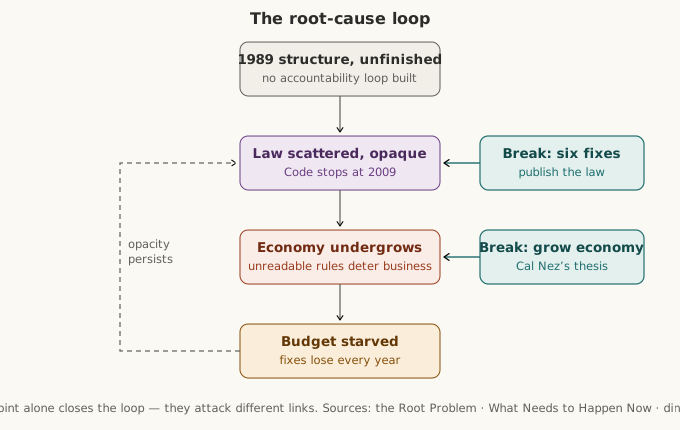
Not a conspiracy — the record doesn’t show one, and this site doesn’t claim what the record doesn’t show. What it shows is a government built in a hurry in 1989 and never finished, where opacity costs nothing to the people who could fix it and the fixing always loses in the budget. The remedy isn’t anger at any person. It is a ledger, a map, a field guide to the tactics, and a people who use their rights until using them is normal. That is what this whole site is: a chapter house meeting that never adjourns — facts on the table, tools in reach, and every verdict left where it belongs. With you.
TAKE ACTION
Pick your door
Find your candidates · take the 5-step journey · find a law · tell us which fixes you’d back · or take the 90-second challenge and see all of this for yourself.