
THE VISION · WHERE AUTHORITY CHANGES HANDS
The seams
≈ 11 min read · or listen, or skim the bold lines
A · Primary source Each seam below is marked with what has been verified and what has only been claimed. Statutes were read in the Code or the resolution itself. How we verify →
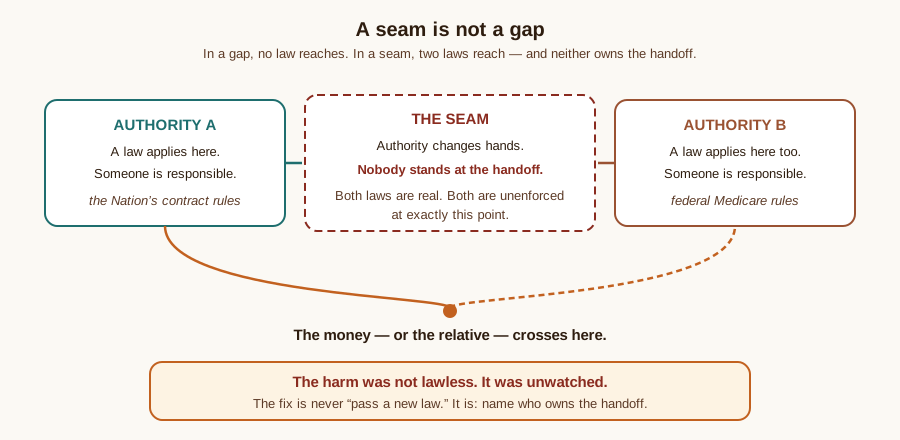
People say “loophole” when they mean something else. In almost everything we found, the law applied. Nobody was outside it. The rules were real, and nobody was standing where they met.
The three words, in one sentence each
Loophole — the rule lets them do it.
Gap — there is no rule.
Seam — there are two rules, and nobody is standing where they meet.
Almost everything we found is the third one. The rule existed. Nobody was watching that spot.
Three words that are not the same
Loophole
The law permits it. Someone drafted around the rule.
Gap
No law reaches the conduct at all.
Seam
Laws exist on both sides. Authority changes hands — and nobody owns the handoff.
Why this matters more than “loophole”
You cannot close a loophole that isn’t there. If the problem were bad drafting, the answer would be to rewrite the rule. That is not what happened.
- ZenniHome: 2 N.N.C. § 223(E) required public advertisement and bidding. § 223(F) capped change orders at twenty percent. Nobody checked.
- The wound-graft prosecutions: the federal Anti-Kickback Statute applied — and the Justice Department did prosecute. The Navajo Nation had no role.
- A HIPAA violation at a 638 facility: HIPAA applies fully. The Nation does not enforce it.
The harm was not lawless. It was unwatched.
The seams — verified
1. Prime contractor → subcontractor
The Navajo Business Opportunity Act (5 N.N.C. § 201) governs who the Nation contracts with. It does not plainly reach whom a Navajo prime contractor hires as a subcontractor.
2. Care given on the Nation → bill sent to a federal payer
CO-50-14 gave the Navajo Department of Health no authority to license physicians or clinics, and — in the President’s own transmittal memo — no power to “intercept or impede existing self-determination funding.” An outside company can treat Diné patients here and bill Medicare directly. The Nation never sees that bill.
3. Navajo law → non-Indian conduct
Oliphant v. Suquamish (1978): tribal courts have no inherent criminal jurisdiction over non-Indians. Only Congress can change that.
But Montana v. United States (1981) permits a tribe to regulate — “through taxation, licensing, or other means” — nonmembers who enter consensual commercial relationships with it. The Council did not grant that licensing power.
4. The statute → the citizen
The published Navajo Nation Code stops at 2009. The Judicial Branch says copyright prevents posting most statutes. The government’s amendment index begins in 2014.
And the Supreme Court’s own opinions are sold in print — Navajo Reporter volumes, $45 to $100 each, at the Diné College Book Store. In one quarter, the Judicial Branch recorded six sales.
This is the seam under all the others. A rule nobody can read is a rule nobody can invoke.
5. The employee → protection
The Navajo Nation has no whistleblower act. The NPEA prohibits adverse action without just cause — a real protection — but contains its own anti-retaliation provision at § 610(N).
6. The ruling → the precedent
The Navajo Nation Labor Commission does not publish its decisions. Neither an employee nor an employer can read how “just cause” has been applied.
A standard nobody can look up is not a standard.
7. Medical privacy → enforcement
HIPAA is federal. The U.S. Office for Civil Rights enforces it — not the Nation. A 638 facility is a covered entity under law the Nation does not enforce.
The seams — established from public record
- 8. Recruited on the Nation → harmed off it. Relatives were recruited here and taken to the Valley; the bills went to Arizona Medicaid. The sober-living case study →
- 9. Referred on the Nation → treated in a border town. A clinic outside every oversight ring the Nation controls. Modern Vascular →
- 10. Ethics complaint → jurisdiction. A special prosecutor’s complaint was dismissed for lack of jurisdiction. The court never reached the charges.
- 11. Council remedy → judicial stay. Nobody could agree who had authority. A court froze the proceedings, warning of “the potential to obliterate the separation of powers.” No allegation has been proven; this site takes no position on them.
Claimed — not verified
12. Certified chapter → the Auditor General
Council candidate Lewnell Harrison, a former Ethics & Rules investigator, told Cal Nez that after certification chapters “hire their own CPAs… they don’t go through Auditor General’s office anymore.”
We cannot confirm this. A separate resolution, RDCD-43-22, appears to have centralized oversight of chapter capital projects. Both may be true in different places — certified chapters may levy sales tax under CJN-48-20 while capital projects route through Window Rock.
Somebody has to read Title 26. Until then, this is a candidate’s account, marked as one.
The anatomy of a seam
Every one has the same shape
Authority moves. Money follows. Nobody is standing at the handoff.
Which means the fix is almost never “pass a new law.” It is: name who owns the handoff.
- Publishing the Code names an owner.
- Publishing the Labor Commission’s decisions names an owner.
- Funding the Auditor General to hire investigators names an owner.
- Deciding whether the Health Department may license physicians names an owner.
What to ask a candidate
- When a Navajo-owned prime contractor hires a non-Navajo subcontractor, which law governs that subcontract?
- When an outside company bills Medicare for care given to Diné patients on the Navajo Nation, who is supposed to see that bill?
- Montana v. United States permits a tribe to license nonmembers who contract with it. CO-50-14 granted no such power over physicians. Would you grant it?
- The Labor Commission does not publish its decisions. Would you publish them?
- After a chapter is certified, who audits it?
Every one of these can be answered without a section number. They name no person and accuse no one.
Related: The Root Problem & To-Do List · The Runaround · Who watches the money? · What you can do now · How we verify
The decisions behind these seams: Oliphant, Montana, and the rest →
Why this law exists
In 1987 a middleman bought a ranch for $26.25 million and sold it to the Navajo Nation five minutes later for $33.4 million. Two years of crisis followed. On July 20, 1989, Arnold Begay and Jimmy Dixon were killed outside the finance building in Window Rock.
Five months later the Council wrote 2 N.N.C. §§ 223–225: advertise the contract, take bids, cap change orders at twenty percent, file it, and let the people see it. In the same resolution they ordered that the law be codified immediately.
§ 3749 reaches an official who benefits. § 223(E) is enforced only if an aggrieved bidder protests within fourteen days (12 N.N.C. § 360) — and nobody is required to tell a business a contract exists. Who enforces what →
Correction — July 9, 2026. We were wrong about the NBOA.
A · read in the Navajo Nation Code Annotated
This site said, repeatedly, that the Navajo Business Opportunity Act governs who gets a contract but does not require competitive bidding — and that candidates who blamed the NBOA for the housing loss had named the wrong law.
That was wrong. They named the right law.
5 N.N.C. § 205 — Navajo Business Opportunity Procedures in Bidding and Procurement
(B) Advertisement and notice. After preparing a bid or request for proposal solicitation, the procuring entity shall:
1. Provide notice or invitation to bid in a newspaper having general circulation within the Navajo Nation; or
2. Provide notice or invitation to bid by mail or telefax to certified businesses listed on the Navajo Nation Business Source List compiled and maintained by the Business Regulatory Department; and
3. The notice shall include the specifications, the deadline dates for submission of bids, bid openings, award, and the necessary qualifications.
§ 205(C) requires the maximum feasible price to be determined before bids are solicited.
And it names an enforcer
§ 209(A): “All proposed professional services, procurement and construction contracts shall be initially reviewed by the Business Regulatory Department for compliance with the Act.”
§ 209(B): the Department shall investigate any alleged violation on receipt of a written complaint, prepare a written summary of facts and witness statements, seek voluntary compliance, and if that fails, render a decision. § 209(C) provides for interim project suspension, temporary restraining orders and permanent injunctions.
§ 210 — sanctions: civil fines up to $500 per day, per violation; suspension or termination of a party’s authorization to do business on the Navajo Nation; a bar on future business, for a period or permanently.
What this changes
- Curtis Yanito was right. He said the housing loss would have been prevented if the NBOA had been followed. § 205 requires advertisement of the bid.
- Jerilynn Yazzie was right to name the NBOA and the NPEA together.
- § 204 certifies a Priority #1 business as one hundred percent Navajo-owned. § 205(B)(2) says notice of an invitation to bid shall be provided to certified businesses on the Navajo Nation Business Source List.
- One candidate — a Priority #1 certified, registered, 100% Navajo-owned business — told Cal Nez that only one chapter had ever invited her to bid.
That is no longer an anecdote. It is a question about a statutory duty.
2 N.N.C. § 223(E) and 5 N.N.C. § 205 are not rival laws. They are the same requirement, written twice. 12 N.N.C. § 331 confirms it: competitive sealed bidding “shall be conducted in a manner consistent with the procedures set forth in the Navajo Nation Business Opportunity Act, 5 N.N.C. § 205.”
And five Titles are not in the published Code at all
The volume lists them. It does not print them.
A · verified page by page in the Navajo Nation Code Annotated
The published Code Annotated opens with a table of contents naming Titles 1 through 26.
Twenty of them are printed. Five are not.
Five Titles of the published Code — including Title 3 (grazing) and Title 26 (the Local Governance Act) — were never printed in the volumes. The full Title-by-Title table lives on one page, kept current in one place: which Titles are in the volume →
What that means, in plain words
A Diné person holding the published Code cannot read the law that governs their grazing permit.
They cannot read the law that governs their land.
They cannot read the law that governs their chapter.
They cannot read the law that governs who inherits when a relative dies.
And twelve days before a primary, they cannot read the election law.
Why this explains what the interviews showed
Andrew Curley calls land reform the number one issue on the Navajo Nation. He researched it at the Diné Policy Institute. The law he is talking about is not in the published Code.
Lewnell Harrison says certified chapters no longer go through the Auditor General. Nobody can check him. Title 26 is not in the published Code.
Of the 42 candidates on the record (as of July 2026), one — LaVonne Tsosie — cited sections of Navajo law on tape: Title II §102 and the §164 review process.
Three others cited Section 17 — a federal provision. Title II is one of the Titles that IS published. The pattern holds: people cited the law they could read.
Related reading — a companion, not a verified seam
The Gray Zone: why a tribal business is the hardest thing to hold accountable — not a seam in the strict sense above (its sources are secondary, tier C, not statute read directly), but the same shape of problem: an entity in the space between two sovereigns’ rules, claimed fully by neither. Read it for the pattern; hold it to the lower verification bar it declares.