
Special Interview · The Record · Election 2026
The President, On the Record
President Buu Nygren sat down with Cal Nez on Politics on the Navajo Nation to address one subject: the $24 million. The interviewer arrived with the entire contracting blueprint in hand. The President was asked the signature question twice. Both answers are on video — and they change what the open questions are.
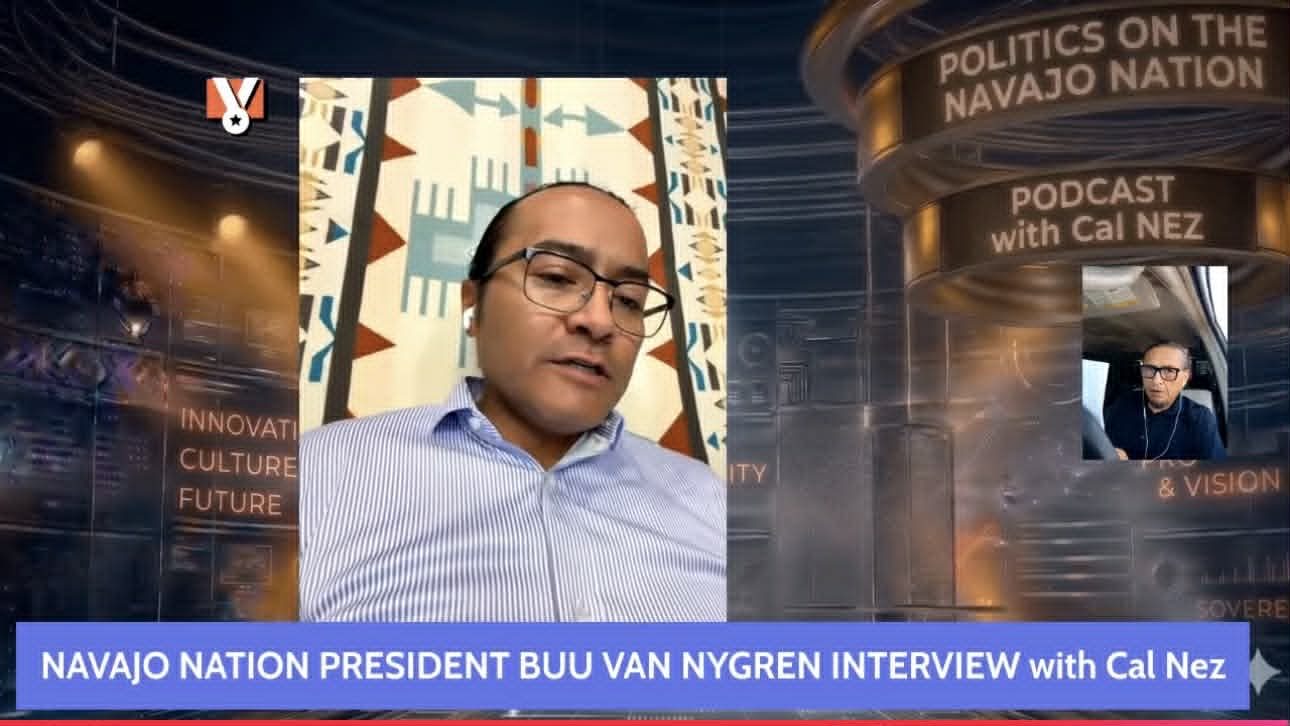
For most of this election cycle, the sitting President had not appeared in Cal Nez's interview archive. That changed when President Buu Nygren joined Politics on the Navajo Nation — not to sit for the standard candidate interview, but to address the $24 million question directly. What follows is a report of what was said on video — the claims each man made, labeled as claims — plus this website's analysis of where those statements agree with each other, where they strain against each other, and which of them a document could settle.
The interviewer came with the blueprint
This was not an ambush and it was not a softball. Before the President arrived, Cal spent the opening of the episode teaching his audience — step by step — the exact machinery his questions would later travel. He walked the full 164 route in order: the Signature Authorization Sheet that starts the packet; the division director's certification; the budget requirement; the Business Regulatory Department's audit at step four, where, in his words, "business regulatory will reject the SAS as insufficient" if a non-certified vendor was chosen over a certified Navajo business without documented justification; the Department of Justice's legal review; the executive branch; and the purchasing department that receives the signed packet at the end. He explained that "the vendor must pass a background financial screen under the NBOA" before award.
He also laid his own credentials on the table before asking anyone else to answer for theirs:
"I did contracting with the Navajo Nation for 40 years myself. I know all the step by step." — Cal Nez, on video; elsewhere: "I've signed purchase I've signed soul sourcing. I've signed contracts with the Navajo nation."
So when the signature questions came later, they came from an interviewer who had already told his audience precisely which desk each signature sits on, and had personally signed the same forms for four decades. That preparation is why the exchange below is as clean as it is: the question was built so that any answer would land somewhere specific on a map the listeners had already seen.
To see the full route drawn out — the lawful path, and the paths the money actually took — see The ZenniHome Money — Four Charts.
Two pots of money, not one
Much of the public conversation around ZenniHome and the IDSA housing work has treated the dollars as one lump. On video, the two men drew the line differently — and where they drew it matters.
Cal put the first figure to the President directly, in his words: "The twenty four million dollar grant that is now unaccounted for." That characterization — unaccounted for — is Cal's, stated as his understanding on video.
Nygren's answer separated the money into two pots: a $24 million grant and a $50 million housing contract. On the grant, his claim on video is that "the grant never got distributed" and that the money is "still within the coffers of the Navajo Nation." On the contract, he said it went through the full 164 route — "I'm the last person that signs off on it."
Two competing on-video characterizations of the $24 million: the interviewer calls it "unaccounted for"; the President says it "never got distributed" and remains in Navajo Nation coffers. This page does not adjudicate between them — but note that these cannot both be fully right, and a controller's-office record would settle it. See the open-questions section below.
Asked twice, answered twice
The first time Cal raised the signature question, the answer came hedged. Asked "Did you sign off on this twenty four million?", the President replied:
"I signed off on a 50. I think I again, I I assume I think I signed off on the 50 million contract." — President Buu Nygren, first exchange (disfluencies preserved from the transcript)
Later in the interview, Cal asked again — plainly. The exchange, verbatim:
Cal Nez: "Did you sign the SAS?"
President Nygren: "Hello?"
Cal Nez: "Yeah. Did you sign the SAS?"
President Nygren: "Yeah. For the 50 million?"
Cal Nez: "So you're fully aware of that." — second exchange, verbatim from the transcript
On video, President Nygren confirms he signed the Signature Authorization Sheet for the $50 million housing contract — hedged in the first exchange, plainly in the second. He does not confirm signing anything for the $24 million grant; his on-video claim is that the grant was never distributed. Any retelling that attaches his "yes" to the $24 million figure does not match the transcript.
What the yes changes
An answered question closes some doors and opens others. For a year, much of the public argument has circled one premise: maybe the money moved without proper authorization. The President's confirmation removes that premise for the $50 million contract. By his own account, the process ran its full route and ended at his desk, where he signed.
Nygren himself argued that the route's density is the public's protection:
"when someone says there's $24 million missing, the president pocketed $24 million, or whatever the case is, that process is almost impossible to penetrate because you can't get it done because there's so many checkoffs" — President Buu Nygren, on video
But the same confirmation sharpens the question that remains. Cal put the standing question in one sentence near the close:
"if everybody signed off on the SAS, how did this company get this amount of money?" — Cal Nez, on video
That is the shape of the open question now: not was it authorized — the video answers that for the $50 million — but what happened downstream of a fully signed authorization. In this website's terms, the interview moves the ZenniHome story from a referee question toward a plumbing question: the signatures all exist, and the dispute is about where the pipe ran after them.
Reading the record side by side — this website's analysis
Everything above reports. This section analyzes — strictly by holding the interview's own statements next to each other. Two tensions stand out. None of them is an accusation; each is a place where the record, as it stands now, does not fully close.
First: the hedge that became a yes. Within a single interview, the President's answer to the same question moved from "I think I again, I I assume I think I signed off on the 50 million contract" to a plain "Yeah. For the 50 million?" People do firm up recollections mid-conversation — that is human. But a president's signature on a $50 million SAS is not a small thing to be unsure about, and the final signature line is, by his own description, his alone. The uncertainty itself is part of the record.
Second: the last signature and the vanishing view. The President described himself as the end of the authorization line — "I'm the last person that signs off on it" — and separately said that "as president, I signed hundreds of millions of dollars in contracts." Yet describing what happens after signing, he said the packet "goes back to the controller's office, and then it goes through that process, and then the divisions, they're the ones, the programs that manage a lot of those resources" — and "I never even see it again." Both statements can be true, and together they describe the system, not just the man: the office with the ultimate authorizing signature claims no visibility into what its signature sets in motion. Whether that is a defense or a design flaw is exactly the kind of question the November referendum asks voters to think about. Readers can weigh it.
Held side by side, the interview's statements resolve one big question (the $50M SAS was signed, by the President, at the end of a fully-routed 164 process) and leave a specific short list open: the status of the $24M, the "25 million" reference, the IDSA procurement question, and the gap between last-signature authority and claimed zero downstream visibility. Every item on that list is checkable against a document. None requires anyone's word.
Open questions a document could settle
This website's standard is that a gap is only named when a source could close it. Each item below names the claim, the tension, and the record that would settle it.
The $24 million's location. Claim on video (Nygren): "still within the coffers of the Navajo Nation." Competing characterization on video (Nez): "now unaccounted for." Settled by: Office of the Controller fund records for the appropriation in question. If the money sits in an account, a ledger line says so. The public record shows this document has been actively sought: at the Council's Spring Session in April 2026, the Controller reported that his office continues to receive conflicting information from the Office of the President and the Division of Community Development, complicating efforts to track the funds.
Whether IDSA was excluded from procurement. Cal asked: "But I also know that IDSA got excluded in the procurement process. Am I wrong on that?" The President's answer, in full: "Excluded? I think they're there. We contracted." That is not a resolution; it is two people with different understandings. Settled by: the procurement determination and Business Regulatory Department review for the housing contract — the exact step-four audit Cal described in his opening.
The grant's actual status. The President said ZenniHome "tried to apply for a grant. The grant didn't happen" — and also that the $24 million grant money remains in the coffers. Was the grant applied for and denied, awarded and undistributed, or never finalized? These are different administrative events with different paper trails. Settled by: the grant file — application, award letter or denial, and disbursement record.
Downstream of the signature. Cal's closing question — how the company received what it received if every checkpoint signed — is answered by pay applications and controller disbursement records, the documents the President himself said are "run at that level" after his signature.
None of these documents is exotic. Every one of them is generated by the ordinary operation of the 164 process this interview so carefully explained. The public asking for them is not an attack on anyone — it is the process working.
The wider record
This interview sits inside a larger public record, and both sides of it are official and linked from this website. The Council's Budget and Finance Committee has held investigatory hearings under Legislation 0174-25 and characterizes its inquiry as fiduciary responsibility; the President's office states that no money is missing and characterizes the narrative as election-driven. A special prosecutor's review is ongoing; nothing has been ruled. For the paths of the money drawn out chart by chart, see the four charts; for the testimony record, see the ZenniHome record page. This page keeps to the interview itself.
The site lease, in his own words
The President also gave his own account of why he approved ZenniHome's permanent business site lease after initially opposing it:
"my tune changed right there because I went from, no, not going to sign this business site lease, get these guys out of here, not a fan of this, and then I go and visit the facility, and it's about over 100 Navajo people working, and I was like, who am I to say, like, this shouldn't happen?" — President Buu Nygren, on video
On the scale of his signature power generally, he said "contracting is a risk every time." Those are his characterizations of his own office, offered as the sitting President.
Where the interviewer landed
Cal closed the episode in his own voice, and he did not close it in agreement. Responding to the President's suggestion that voters "elect council delegate that support the president," Cal pushed back on the premise itself:
"They're not supportive of each other. But they're supposed to be there to work together. They're checks and balances with each other." — Cal Nez, closing commentary
That disagreement — whether the branches should align or check each other — is itself a live question on the November ballot, where the proposed constitution would redraw how the branches hold one another to account. The reader can weigh the President's view and the interviewer's side by side.
The Signature Authorization Sheet and the 164 review route are established under Title II of the Navajo Nation Code (2 N.N.C. §164). The full interview transcript is held in this website's archive; every quotation above was verified against it word-for-word, disfluencies preserved.
What this page is — and isn't
This is a report of what two people said on video, with each claim labeled as a claim, each verified fact labeled as a finding, and this website's analysis confined to holding the record against itself. It does not score the interview, grade the answers, or tell you what to conclude about the $24 million, the $50 million, ZenniHome, or the President's candidacy. Where the record doesn't close, we named the document that would close it. The record is here. The verdict is yours.
Listen to the full interview on Politics on the Navajo Nation. Read his profile alongside every 2026 presidential candidate on this website — and note that the standard interview every candidate gets remains open to him. If the open questions above matter to you, the records that answer them are public records — request them (how →). The people matter more than any candidate.
Every quotation on this page is verbatim from the interview transcript, including hesitations and repeated words, per this website's quote covenant: verbatim or stance-with-receipt, never paraphrase. Characterizations ("unaccounted for," "never got distributed") belong to their speakers and are labeled as such. The analysis section compares on-video statements only against each other and against documents named in the text; it accuses no one and endorses no one. This page reports; it does not score or rank.